Categories
Uncategorized

The UK’s AI Summit – a missed opportunity

JAAG is today pleased to join with over 100 concerned civil society organisations and individuals in addressing an open letter to the UK Prime Minister about the much – vaunted UK Global Summit on AI Safety.

We point out that many millions of people are already feeling the harmful effects of AI: whether they have been fired from their job by an algorithm, or been subject to authoritarian biometric surveillance, or seen their small business squeezed out by big tech companies.

Yet the communities and workers most affected by AI have been marginalised, and civil society has been sidelined, by the Summit.

JAAG believes that these issues can only be tackled if those who are most exposed to AI harms are fully involved in discussions and debate. Only if the whole of society is given a voice can we ensure that the future of AI is as safe and beneficial as possible for everyone.

An open letter to the Prime Minister on the ‘Global Summit on AI Safety’ 

Dear Prime Minister,

Your ‘Global Summit on AI Safety’ seeks to tackle the transformational risks and benefits of AI, acknowledging that AI “will fundamentally alter the way we live, work, and relate to one another”. 

Yet the communities and workers most affected by AI have been marginalised by the Summit.

The involvement of civil society organisations that bring a diversity of expertise and perspectives has been selective and limited. 

This is a missed opportunity. 

As it stands, the Summit is a closed door event, overly focused on speculation about the remote ‘existential risks’ of ‘frontier’ AI systems – systems built by the very same corporations who now seek to shape the rules.

For many millions of people in the UK and across the world, the risks and harms of AI are not distant – they are felt in the here and now.

This is about being fired from your job by algorithm, or unfairly profiled for a loan based on your identity or postcode.

People are being subject to authoritarian biometric surveillance, or to discredited predictive policing.

Small businesses and artists are being squeezed out, and innovation smothered as a handful of big tech companies capture even more power and influence. 

To make AI truly safe we must tackle these and many other issues of huge individual and societal significance. Successfully doing so will lay the foundations for managing future risks.

For the Summit itself and the work that has to follow, a wide range of expertise and the voices of communities most exposed to AI harms must have a powerful say and equal seat at the table. The inclusion of these voices will ensure that the public and policy makers get the full picture.

In this way we can work towards ensuring the future of AI is as safe and beneficial as possible for communities in the UK and across the world.


Signed:

  • 5 Rights Foundation

  • Access Now

  • AI Now Institute

  • Amnesty International

  • ARTICLE 19

  • Avaaz Foundation

  • BARAC UK

  • Big Brother Watch

  • BWI Global Union, representing 12 million workers globally

  • Center for Countering Digital Hate (CCDH)

  • Centre for Technomoral Futures, University of Edinburgh

  • Child Rights International Network (CRIN)

  • Community Union

  • Connected By Data

  • Consumers International

  • Data & Society

  • Data, Tech & Black Communities CIC

  • Defend Democracy

  • Derechos Digitales

  • Education International

  • Elanta Services

  • Eticas Tech

  • European Trade Union Confederation (ETUC), representing 45 million members from 93 trade union organisations in 41 European countries

  • Fair Trials

  • Fair Vote UK

  • Finance Innovation Lab

  • ForHumanity

  • Glitch

  • Global Action Plan

  • Global Witness

  • Homo Digitalis

  • Inclusioneering

  • IndustriALL Global Union representing over 50 million workers in 140 countries

  • Institute for the Future of Work

  • International Trade Union Confederation, representing 191 million trade union members in 167 countries and territories

  • International Transport Workers Federation, representing 18.5 million workers globally

  • IPANDETEC

  • Just Algorithms Action Group 

  • Just Treatment

  • Kristophina Shilongo, Senior Mozilla Fellow in Tech Policy

  • Liberty

  • Migration Mobilities, University of Bristol

  • Mozilla

  • NASUWT, teachers union

  • National Education Union

  • National Union of Journalists

  • Open Futures

  • Open Rights Group

  • Privacy International

  • Prospect union

  • Public Law Project

  • Research ICT Africa

  • Reset Tech

  • Safe Online Women Kenya

  • Statewatch

  • StopWatch

  • Superbloom

  • The American Federation of Labor and Congress of Industrial Organizations (AFL-CIO), representing 60 unions and 12.5 million American workers

  • The Citizens

  • The End Violence Against Women Coalition 

  • The Open Data Institute

  • The Racial Justice Network

  • The Trade Union Advisory Committee to the OECD

  • The Trades Union Congress, representing 6 million UK workers

  • TSSA – the union for people in transport and travel

  • Understanding Patient Data

  • UNI Europa Union, representing 7 million European service workers

  • UNI Global Union, representing 20 million service workers in 150 countries

  • UNISON – the public service union

  • UNITE the Union

  • United Tech and Allied Workers

  • United We Rise Uk

  • USDAW – Union of Shop, Distributive and Allied Workers

  • WHAT TO FIX

  • Worker Info Exchange

  • Adam Leon Smith, Chair of British Computer Society Fellows Technical Advisory Group

  • Andelka Phillips, Senior Lecturer in Law, Science and Technology, University of Queensland

  • Baroness Dawn Primarolo, former MP

  • Baroness Frances O’Grady, former General Secretary of the TUC

  • Burkhard Schafer, Professor of Computational Legal Theory, University of Edinburgh

  • Dr Alex Wood, University of Bristol

  • Dr Gina Helfrich, Centre for Technomoral Futures, University of Edinburgh

  • Dr Julian Huppert, University of Cambridge and former MP

  • Dr Mike Katell, The Alan Turing Institute

  • Dr Miranda Mowbray honorary lecturer in Computer Science at the University of Bristol

  • Dr Nora Ni Loideain, Information Law & Policy Centre, Institute of Advanced Legal Studies, University of London

  • Dr P M Krafft, Creative Computing Institute

  • Dr Richard Clayton, Director, Cambridge University Cybercrime Centre 

  • Dr. Cristina Richie Lecturer of Ethics of Technology at University of Edinburgh

  • European Center for Not-for-Profit Law

  • Ismael Kherroubi Garcia, CEO of Kairoi 

  • Judith Townend, Reader in Digital Society and Justice, University of Sussex

  • Kate Baucherel, Galia Digital

  • Lord John Monks, former General Secretary of the TUC

  • Maria Farrell, writer and Senior Fellow At Large, University of Western Australia Tech and Policy Lab

  • Mick Whitley MP

  • Neil Lawrence, University of Cambridge DeepMind Professor of Machine Learning and Senior AI Fellow at The Alan Turing Institute

  • Peter Flach, Professor of Artificial Intelligence, University of Bristol

  • Phoebe Li, Reader in Law and Technology, University of Sussex

  • Professor Alan Bundy, the School of Informatics at the University of Edinburgh

  • Professor Alex Lascarides, University of Edinburgh

  • Professor Douwe Korff, Emeritus professor of international law, European human rights and digital rights expert

  • Professor Lilian Edwards, Newcastle Law School

  • Professor Martin Parker, University of Bristol Business School

  • Professor Nathalie Smuha, KU Leuven Faculty of Law & NYU School of Law

  • Professor Peter Sommer, Birmingham City University

  • Professor Sara (Meg) Davis, University of Warwick

  • Professor Sonia Livingstone, London School of Economics 

  • Professor Sue Black OBE, Durham University

  • Professor Vijay Varadharajan, Advanced Cyber Security Engineering Research Centre (ACSRC), The University of Newcastle, Australia

  • Rachel Coldicutt, Executive Director, Careful Trouble

  • Shân M. Millie, Bright Blue Hare

  • Tabitha Goldstaub, former chair of the AI Council

  • Tania Duarte, founder of We and AI

  • Thompsons Solicitors

  • University and College Union (UCU)


Categories
Uncategorized

MPs demand stop to live facial recognition surveillance

65 UK MPs and peers, from all political parties, have called for the use of live facial recognition surveillance to be put on pause.

The group of MPs – which includes Conservative MP David Davis, Labour politicians Diane Abbott and John McDonnell, and Liberal Democrat leader Ed Davey – called on UK police and private companies to immediately stop using live facial recognition for public surveillance.

British police have used live facial recognition technology (FRT) at public events, including the coronation of King Charles II and the British Grand Prix. However, this technology has long been criticised by civil liberties groups as an invasion of privacy.  

The use of “static” FRT seems well established. The policing minister, Chris Philp, has acknowledged that all 45 police forces are currently using FRT. He plans to set up ‘national shoplifting database’ to include the passport photos of all 45 million adults. September saw the launch of Project Pegasus, in which the country’s biggest retailers will hand over their CCTV footage to the police who will run them through their databases using this facial recognition technology to identify shoplifters. Critics say that using passport photos – which people only provide for the purposes of travelling – to track them when they go to the shops is an extreme invasion of privacy.

The parliamentarian’s concern is specifically with “live” facial recognition, such as using a camera on top of a police van to scan everybody who walks past in real time, and then running the images through a database of our “faceprints” – including images taken from social media accounts. Police officers could even use their phone to scan someone’s face and run it through a database of sensitive biometric data.

History suggests that surveillance technology is likely to be targeted at minority groups, especially people of colour. When the Metropolitan Police first trialled this technology, they often deployed it in socially deprived areas and at events attended primarily by people of colour – such as the Notting Hill carnival. MIT research in 2018 found that facial recognition software made mistakes in 21% to 35% of cases for darker-skinned women, but the error rate for light-skinned men was less than 1%.

In June, the European Court of Human Rights described facial recognition technology as highly intrusive, and ruled that using it to identify and arrest participants of peaceful protests could have “a chilling effect in regard of the rights to freedom of expression and assembly”. Use of FRT could soon be banned in the EU under forthcoming legislation.

The MPs’ statement listed many areas of concern with FRT:

  • its incompatibility with human rights,

  • the potential for discriminatory impact,

  • the lack of safeguards,

  • the lack of an evidence base,

  • an unproven case of necessity or proportionality,

  • the lack of a sufficient legal basis,

  • the lack of parliamentary consideration, and

  • the lack of a democratic mandate.

JAAG believes that the use of this technology, which has serious implications for individuals’ privacy, must be paused. There needs to be a full public debate about it, and Parliament must review its implications and establish stringent safeguards; the use of any such technology should always be subject to Parliamentary scrutiny.

Sources

Reuters: https://www.reuters.com/world/uk/british-lawmakers-call-pause-live-facial-recognition-surveillance-2023-10-05/?mkt_tok=MTM4LUVaTS0wNDIAAAGOxjhzn1Xvn1NdJvQ3nthoue-1pxGGIE85YgcMclKNQrQ-E86i5idiRDYABZjD4qllZ8we-4ILh2LsBmbf3GdPkOz-1NSUFBDqZvv6VzfDkRG_

https://www.theguardian.com/technology/2023/oct/06/mps-and-peers-call-for-immediate-stop-to-live-facial-recognition-surveillance

https://www.theguardian.com/technology/2023/jul/08/police-live-facial-recognition-british-grand-prix?CMP=Share_AndroidApp_Other

https://www.theguardian.com/commentisfree/2023/oct/12/shoplifting-facial-recognition-shops-police-surveillance-powers?CMP=Share_AndroidApp_Other

Categories
Uncategorized

JAAG commits to Equality, Diversity and Inclusion

JAAG’s new policy on Equality, Diversity and Inclusion came into effect yesterday (27 March 2023).

“JAAG exists to promote justice and equality in the growing number of systems that use algorithms and Artificial Intelligence to make decisions that affect our everyday lives. We want these decisions to be fair, and be seen to be fair”,

said Eoin McCarthy, one of JAAG’s founding Directors.

Siani Morris, Director, added:

“Our organisation is campaigning for greater social justice, and so it’s logical that we are also committed to embracing diversity and inclusion not only among our membership, but also in our Board and our workforce”.

The policy commits JAAG to employ best practices that encourage equality, diversity and inclusion in its workplaces, and to avoid discrimination (in appointments, pay, conditions of employment etc.) on the basis of characteristics such as gender, disability or sexual orientation.

Categories
Uncategorized

Data Protection Bill – UK government tries again

After months of delay, and changes in Ministers, the UK Government introduced their revised version of this Bill into the House of Commons on 8 March 2023.

Following an in-depth, 50-page analysis of the Government’s proposals, JAAG had expressed many concerns about the first version of the Bill, published in the summer of 2022. That version contained many clauses that would have undermined individuals’ rights. In particular, JAAG wanted it to be amended so that:

⮚     People could be able easily to find out how their personal data is being collected and used.

⮚     Stronger safeguards would apply to the high-risk processing of personal data

⮚     Organisations that process personal data would be held accountable.

⮚     There would always be human oversight of decisions made by machines, so that people know how decisions about their lives are being taken.

⮚     The Information Commissioner’s Office would be fully independent.

⮚     Any changes to data regulations would be subject to scrutiny by Parliament.

The Government stresses that the revised version of the Bill has been ‘co-designed’ with business’ and will ‘cut down pointless paperwork for businesses’ by giving them ‘more flexibility about how they comply’. The CBI have welcomed the Bill.

Incredibly, civil society organisations like JAAG were excluded from these behind-closed-doors consultations. JAAG this week joined with other like-minded groups to publish a second open letter to the Minister, criticising this unfair and undemocratic treatment. We said:

  • the government is setting the country on a dangerous path to further economic instability and the erosion of fundamental rights

  • The new Bill will weaken data subjects’ rights, water down accountability requirements, reduce the independence of the Information Commissioner’s Office (ICO), and empower the Secretary of State with undemocratic controls over data protection.

  • Strong data protection laws provide critical tools for civil society and individuals to protect themselves and hold organisations to account in a data ecosystem where all the power is skewed towards governments and corporations.

  • The Department of Science, Innovation, and Technology must bring data protection reform back to the design stage and ensure that data protection experts, civil society and ordinary citizens are thoroughly consulted, to avoid another Bill based on unsubstantiated evidence and a lopsided consultation process.

JAAG is restarting its line-by-line scrutiny of the new version of the Bill. We will keep you informed.

If you want to help with this project, contact Paul Holdsworth. holdspa[at] gmail[dot].com

Categories
Uncategorized

Effective tech for our Health Service

Zella has prepared a summary for this blog post. Note that pipeline is a term used in AI to describe the set of repeatable, programmed processing steps which prepare the data, validate it, and submit it to a process which in this case generates predictions.

To date, most applications of Artificial Intelligence to healthcare have been applied to clinical questions about diseases and patient care. Now that many hospitals have electronic health records (EHRs), there is potential to use AI for operational purposes. In this study, we present a prediction pipeline that uses live EHR data for patients in a hospital emergency department (ED) to generate forecasts of emergency admissions. This involved using Machine Learning to predict each individual patient’s probability of admission. 

We worked closely with hospital bed managers to understand how to make these patient-level predictions most useful to them. From their point of view, knowing the probability that a particular patient will be admitted is less valuable than knowing in aggregate how many patients to plan for. We therefore developed a pipeline that begins by applying ML to live data for each patient currently in the ED, and then follows a series of steps to convert the ML predictions into aggregate predictions for the total number of admissions. Our predictions outperformed a six-week rolling average benchmark that is conventionally used in hospitals to predict daily admission numbers. 


If you would like to see more detail of her work then Zella reports as follows:

Here is a link to the paper about our work at UCLH predicting demand for emergency admissions. A Twitter thread is here. I wrote a blog about it for the Nature Health community which is here


Zella is the corresponding author of the paper. To discuss this work please contact her at zella.king@ucl.ac.uk.

Categories
Uncategorized

The Data Protection and Digital Information Bill

Personal data: handle with care

We’ve all heard of the problems that have been caused when data about individuals has been misused or misinterpreted, often by machines implementing algorithms that are poorly designed or unfair. You may remember these recent examples:

  • Women with darker skin are more than twice as likely as lighter-skinned men to be told that their photos fail UK passport rules when they submit them online. (click here for more on this)

  • An IBM “Oncology Expert Advisor” system was found to be providing doctors in the USA with erroneous, dangerous cancer treatment advice. (more here)

  • A poorly designed automated credit check caused one man to be labelled “credit unworthy” which then led to his bank account being closed, his credit card being refused credit and mobile phone contracts being refused. ( JAAG 2021 Annual Report)

Proposed changes to data law

At present, the UK Data Protection Act 2018 controls how personal information can be used. It provides a legal framework for keeping everyone’s personal data safe by requiring organisations, businesses and the government to have robust processes in place for handling and storing personal information. Everyone using personal data has to follow strict ‘data protection principles’; for example, they must make sure the information is used fairly, lawfully and transparently, only for specified purposes, and that it is handled in a way that ensures protection against unlawful or unauthorised processing, access, loss, destruction or damage. There is stronger protection for more sensitive information, such as race, ethnicity, religious beliefs, genetics, biometrics, health, sex life etc.

However, the Government intends to change this and other data protection legislation through the Data Protection and Digital Information Bill, currently going through parliament.  

The Bill’s aims are to encourage more data flows, increase revenue and reduce administrative burdens on businesses and small organisations. The government wishes to expand data flows across borders through trade agreements such as the UK-Singapore data agreement that was signed a few months ago. While these aims may be laudable, JAAG believes that the key to their fulfilment will be to do so without reducing protection for individuals. 

Note: the passage of the Bill through the House of Commons was paused by Secretary of State Michelle Donelan to allow the Government to reassess it; this means that the Bill might be altered further by the government before being considered in committee.

JAAG’s analysis

Last November, JAAG sent off a detailed response to the UK Government’s planned changes in the law on data. We said that these far-reaching proposals would significantly weaken individuals’ rights not only to protect their personal data but also to challenge any misuse of their data or loss of confidentiality. JAAG sees this as a human rights issue. 

Earlier this year, despite much opposition from groups representing civil society like JAAG, the Government decided to go ahead with most of their proposals, and published the Data Protection and Digital Information Bill. 

For businesses, one aspect of the Bill that is raising concern is the issue of ‘adequacy’; this term refers to an arrangement whereby the EU assesses whether the data protection legislation in a non-EU country (such as the UK) is sufficiently strong as to allow that country’s businesses to share data with countries in the EU. Some observers say there is a risk that the Bill, by introducing weaker data protection in the UK, might make it unlikely that UK businesses would be allowed to share data with countries in the EU, and vice versa; this might adversely affect those companies’ ability to trade with the EU. Another risk is that UK organisations handling EU citizens’ data (e.g. companies exporting or marketing to EU countries) would have to comply with two sets of legislation, meaning an additional administrative burden and costs.

But what about the person in the street?
What would be the impact of this Bill if it became law?
Would it make it easier for us to control the way that data about us is used?
Could more decisions be taken about us by machines?
JAAG’s project team has analysed the Bill. Here are some key findings.

Important aspects of the current UK law include that: 

  • people have to make a positive decision to allow their information to be stored (e.g. via cookies on a website);

  • people can find out how their personal information is being collected and used;

  • people can be confident that their data has been used only after a thorough assessment of the risks involved; and 

  • people have the right for decisions about them to be taken by human beings, not by machines using artificial intelligence or algorithms alone. 

The Bill, if it becomes law, will change each of these aspects, (and more besides).

Who is using personal information about me?

At present, people can ask any organisation about the data it holds on them, and can make a complaint if they disagree with it. The Bill would make it much easier for organisations to refuse these requests thereby unfairly limiting people’s access to their own data. 

  • JAAG wants Clauses 7 and 9 to be removed from the Bill as they significantly limit people’s ability to find out how their personal data is being collected and used.

Why are they using my personal data?

At present, the law has safeguards to make sure that high-risk processing of personal data can only take place after certain procedures have been followed to assess any risk and to ensure that the organisation processing the data can be held responsible. The Bill would remove the obligation to describe how the data will be used or to consult with those who are impacted by it; instead, organisations would be free to choose how to demonstrate compliance with the law and would ‘self-evaluate’ their efforts. 

  • JAAG wants the Government to remove from the Bill changes that lower these minimum requirements.

Who refused my application – a person or a machine?

At present, the law says that there has to be a human being involved in any decision about a person – decisions cannot be taken by computers alone. The Bill would allow solely automated decision-making in a range of cases. Furthermore, the Bill would limit an individual’s right to know whether automation is being used, to obtain human intervention or to contest decisions. 

  • JAAG wants clause 11 and Section 50C to be removed, so that the requirement for human oversight of decisions is retained and people can know how decisions about their lives are being taken.

Who will support me?

In addition, the Bill would significantly weaken the role of the (currently independent) Information Commissioner’s Office (ICO) in investigating breaches of the rules and assisting citizens who feel they have been unfairly treated. The ICO would become answerable to the Secretary of State (instead of to Parliament). 

  • JAAG wants the ICO to remain fully impartial.

Who makes the law?

Furthermore, the Secretary of State would be given wide powers arbitrarily to change the safeguards in the legislation, without referring the matters to Parliament for approval. 

  • JAAG wants any changes to data regulations to be subject to scrutiny by Parliament.

JAAG’s view

The Data Protection and Digital Information Bill aims to encourage competition by making it easier to use, exchange and store data. This is a complex issue and there are many stakeholders, each with different needs. The challenge is to regulate a sector in which poor practice is well established; individual users cannot know whether the data platform they are using has their interests at heart, or the interests of other organisations. 

JAAG is concerned that, if enacted, the Data Protection and Digital Information Bill could seriously weaken individuals’ rights to protect their personal data and to challenge its misuse or loss of confidentiality.

Subscribe to our newsletter for updates on this and other JAAG projects.


References

Categories
Uncategorized

Conversations with Government can improve your data health.

Conversations with Government can improve your data health.

By Peter Hanley

Consultations are not for everyone. I am going to invite you to think of consultation as a purposeful and useful part of helping society to work better. I will also suggest that if you are a first timer, you think about buddying up with someone with experience of consultations as a way of getting used to how they work and how to approach them.

No one was ever an Olympic swimmer without training and coaching. Consultations are no different, except that you tend not to get a medal for putting in a leading contribution. I have been involved in designing and responding to government level consultations for the best part of 30 years, and the most I got was a warm response email. That was sufficient reward for me to know my work had landed with someone who was part of initiating the consultation.

We need to be clear what a consultation is. It is not the irritating and often unwelcome and unnecessary email/text asking for you to score a delivery service or experience. To me, this is simply data gathering by the supplier that will make no real difference to the product or service.

A consultation is what an organisation, which has a significant role in the governance of a city, region or whole nation (UK), uses when it wants to change how it does business in a way that will affect that group of citizens.

I really enjoy responding to consultations! The bigger and more significant the better.

Consultations are a purposeful and useful part of helping society to work better.

The first consultation I was involved with for JAAG was to comment on: “Competition and Markets Authority Annual Plan Consultation 2021/22” (a link to the original document is here ).

Among the many government interests for inquiry involved was this item of relevance to JAAG: “how auditability and explainability of algorithms might work in practice.” A team of JAAG volunteers compiled the responses in the short time available: 15 Dec 2020 to 28 Jan 2021. Having a clear purpose to focus our attention kept us going; it is unlikely that one group will be able to cover all the topics on which government wants comments.

Purpose

Purpose was relevant when I was the Hon Treasurer for a national faith charity. I became aware of the Financial Reporting Council (FRC) consultation on “Risk Management, Internal Control and the Going Concern Basis of Accounting”. As a treasurer of a charity, I felt I needed to have an in depth appreciation of the meaning of “Going Concern”.

Working through the consultation papers, I gained a really good grasp of this topic, sufficient that some 6 years later the senior partner of our auditing firm said our charity knew more than they did.

Purpose, I have found, helps you to develop an appreciative perspective on a topic. It’s important to allow the creative ideas to flow, which is what government needs and ultimately serves society. If consultations are conducted in a warm and friendly way, then better outcomes stand a better chance of emerging.

Consultations well done are good for our society and good for us; that’s my belief. As I said, you won’t get a medal, but as my Royal Navy officer training director said: “If a job is worth doing, then it is worth doing well”. As volunteers, this clarification of purpose and the good that our contribution could make are important to the relationships we build with other people who see our work.

When we go into submitting consultations, we unknowingly become part of a much bigger team of people, also in search of better ways to do things. I personally find that an amazing and humbling experience.

Peter Hanley is an active member of JAAG and Co-Founder of The Success Laboratory conducting research into the practicalities of achieving success which is fun and less frenetic and damaging to ourselves and our planet.

Categories
Uncategorized

Comfortable with data, but not with AI

CENTER FOR DATA ETHICS AND INNOVATION (CDEI) AND AI REPORT

Source: CDEI: Public attitudes to data and AI: Tracker survey

Comfortable with data, but not with AI 

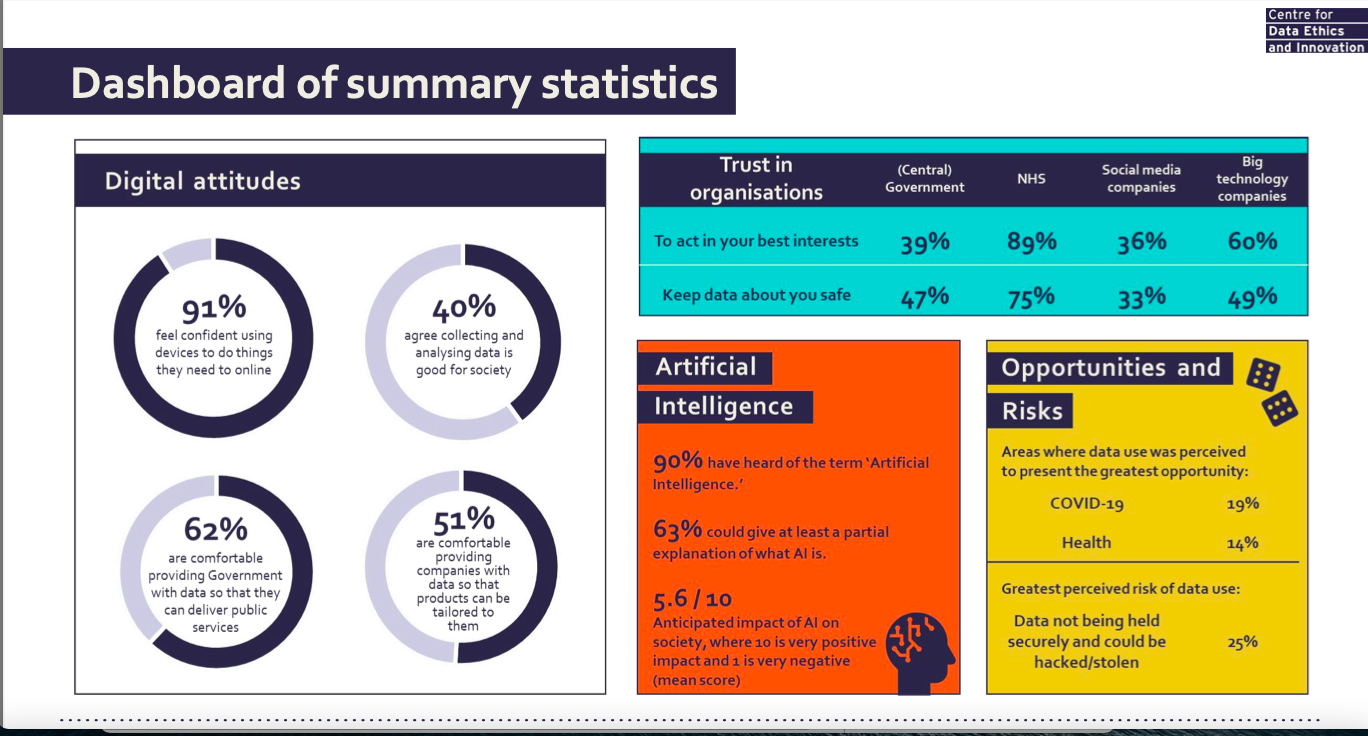
Although British people are now generally comfortable about having organisations use their data, especially for the public good, they find AI “scary and futuristic”. These findings come from the report of the Centre for Data Ethics and Innovation (CDEI) on public attitudes to these aspects of technology

The report gives the results of a survey of more than 4000 online surveys completed by a demographically representative sample of UK adults (18+) between 29 November and 20 December 2021.  A further 200 ‘digitally excluded’ UK adults were interviewed via computer assisted telephone interviewing. 

It is said to be the first study of its type that monitors how public attitudes toward data and analytics change over time. CDEI, which leads the UK government’s work on trustworthy innovation in data and AI, intends these results to serve as a baseline for further research. 

Few people are strangers to the internet today; 93% use it most days or every day. The vast majority of survey respondents reported that they frequently create and use data and data-driven technology. Most said they were comfortable with data being used in a variety of different contexts, especially for the NHS to develop new treatments or for the government to deliver public services. Half said they were comfortable providing companies with personal data to tailor products and services. 

Alarming

By contrast, when it comes to AI, the key insights from the survey were that: 

  • Respondents reported limited knowledge of AI.

  • AI was seen as “scary and futuristic”, especially by those with the least digital familiarity.

  • Many respondents felt that some applications of AI were disturbing.

  • Respondents with higher levels of digital familiarity were more optimistic that applications of AI would bring benefits.

Awareness of AI is high; 90% of the people completing the survey had heard of it, and 63% could give at least a partial explanation, although only 13% could explain in detail. The report comments that this may be as expected as AI covers many technologies and applications, which makes it a challenging term to define and explain. There was no question covering respondents’ awareness of applications of AI in services that they already use. 

Asked about four possible applications, substantial numbers indicated discomfort with AI use. These ranged from 55% : applicants for interviews. When it came to the use of AI for cancer diagnosis or page ranking by search engines, only one third found AI worrying, 34% and 32% respectively. 

Opinions of positive aspects of AI varied with digital familiarity. There was a feeling, especially among the less digitally experienced, that potential benefits would not be evenly distributed across society, especially for small businesses and minority groups. 

Search engines, social media and streaming have made digital services familiar to most people. People know the term AI but are less familiar with its use. One conclusion from the data findings of the report is likely to be relevant to applications of AI as they increase.  Respondents said they were more willing to share data if they were aware of strong governance in place to protect them. 

By Lee Coppack

Categories
Uncategorized

JAAG works with secondary school students on AI ethics

Eoin McCarthy describes a successful pilot introducing 12 and 13 year olds to ethical issues connected with artificial intelligence and machine learning. 

Jon Knight, a member of JAAG and of Malvern Quaker Meeting, was Head of Ethics and Philosophy at Pershore School in Worcestershire.  He now works at Tewkesbury School, a secondary school in Gloucestershire where Zoe Pugh, one of his former students, is Head of Ethics and Philosophy. 

The staff at Tewkesbury School are aware of the impact of technology on their students. Thanks to his reputation in the school, particularly for extra-curricular work with LBGTQ+ students, the school leadership accepted Jon’s offer to conduct an ethics workshop on artificial intelligence and machine learning.

The school has taken particular interest in the workshops and indeed, arising from the success of these pilots, we have a new JAAG project with the 6th formers in the school to explore. 

On the day

Each 55-minute workshop started with an introduction followed by division of each class of 20-30 into small groups.  

Each group had a different coloured dry marker. A scenario describing an artificial intelligence and machine learning ethical dilemma was set out on an A3 page on their table for them to discuss. 

The groups wrote their conclusions on the tables with the distinctively coloured marker. After eight minutes, the groups rotated to new tables and repeated the process with a new scenario. Each session ended with a short session of feedback and review.

One of the project boards showing the contributions from each group.

Follow up

The school children, aged 12 to 13, told us they found it engaging and would like to do more. Professor Simon Rogerson from De Montfort University, former Tewkesbury headteacher Anne Rogerson and Zoe Pugh, together with JAAG’s Eoin McCarthy, observed Jon White deliver the programme. 

Simon and Anne have now completed their evaluations.  We are very grateful for these, particularly as they opened up new learning for us about how we can frame the service we plan. Simon and Anne will continue in touch with the project.

According to Jon Knight, this project offers resources and lesson ideas for schools that allow collaborative debate and imaginative and creative responses to the integration of technology into human experience. It also allows teachers to adapt the resources to fit the needs of their students.

Eoin McCarthy started as a systems engineer and then consulted on logistics in manufacturing industry, before retraining in executive development.   A Fellow of the Institute of Consulting, he has been a contributor to the work of the Quakers and Business Group in the area of ethics and social justice.  

From left : Eoin McCarthy, Mrs Anne Rogerson, retired Head Teacher, Simon Rogerson, Professor Emeritus in Computer Ethics at De Montfort University, Jon Knight

Categories
Uncategorized

A Robo-sampling Revolution in the Music Industry – A Composer’s View, by Joanna Bates

When AI is used in a way that does no harm and seeks to build on historical and accrued knowledge rather than replace it, the result may be the best of both worlds.

Skybox Audio, who are at the forefront in robotic music sampling technology, have devised a keyboard ‘bundle’ of iconic piano and hammered instruments called Hammers & Waves using precision robotic sampling. In doing so, they are making their own waves in the music industry. 

As a composer of music and a user of the Native Instruments Kontakt hardware (NKS – Native Kontrol Standard) and software, I find these sounds truly inspirational in terms of the creativity and individual processing parameters. They can certainly be applied to produce something unique. 

Since the mid ‘Naughties,’ when granular synthesis became the powerful new way to manipulate and modify sound by adjusting pitch, tempo and other formant characteristics independently of one another, the line between sampler and synthesizer all but disappeared. 

That has certainly been the case in the creation of electronic music production. New technologies like digital signal processing techniques used to be the preserve of scientific labs or telecom companies, but with faster computers and processing, application in the creative fields is never far behind.

Fellow composer and music journalist, Reuben Cornell interviewed Danny Dunlap – the founder of Skybox Audio for a blog in January. According to Dunlap, what makes this different from other sample recording processes is that each sample has been “painstakingly sampled by using automated, robotic fingers that apply a precise amount of force to the keys; this keeps the recording and mapping consistent according to force rather than just amplitude. So, this translates to a much more realistic playback under the fingers.” 

The robot is almost completely autonomous and can capture an entire 88 key piano keyboard at 16 velocities per note in about 48 hours.

Dunlap continues: “Hammers & Waves goes way beyond the scope of most standard keyboard libraries; the specially sourced and prepared instruments, the precision playing of the robotic capture and the innovative Kontakt engines all contribute to a supremely playable and ever-inspiring collection.” 

Having looked and listened to some of the promotional media around Hammers & Waves, I certainly agree that the range of creative possibility is incredible — and because of the precision (robotic) sampling technique, it makes laborious tasks such as velocity editing, a thing of the past…almost.

It is worth noting, however, that in the ‘prepared’ piano (a piano with objects) library, to achieve this wondrous adaptation of a prepared piano sound called muted relic – it has been treated with a thick layer of gaffa tape to dampen the sound…and similarly, Obscura Grand (apparently, based on a Yamaha C6 sound) was sampled with felt woven between the hammers and strings to make it incredibly authentic.

So, it seems that co-operation and collaboration with AI technologies can show the way to a bright, innovative future, as long as the proverbial baby still resides in the bathwater – at least some of the time.

JAAGSPIEL” by Joanna Bates

 Images courtesy of Native Instruments & Reuben Cornell