
CENTER FOR DATA ETHICS AND INNOVATION (CDEI) AND AI REPORT
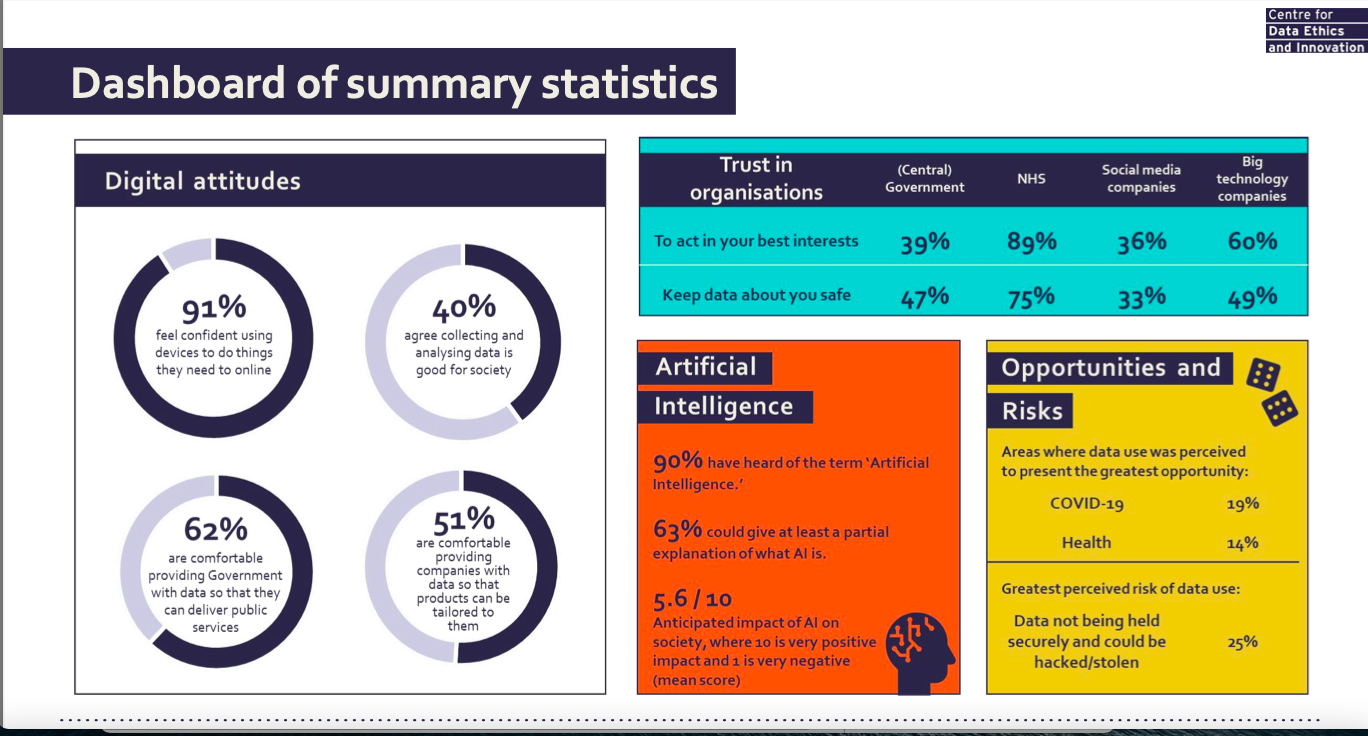
Source: CDEI: Public attitudes to data and AI: Tracker survey
Comfortable with data, but not with AI
Although British people are now generally comfortable about having organisations use their data, especially for the public good, they find AI “scary and futuristic”. These findings come from the report of the Centre for Data Ethics and Innovation (CDEI) on public attitudes to these aspects of technology.
The report gives the results of a survey of more than 4000 online surveys completed by a demographically representative sample of UK adults (18+) between 29 November and 20 December 2021. A further 200 ‘digitally excluded’ UK adults were interviewed via computer assisted telephone interviewing.
It is said to be the first study of its type that monitors how public attitudes toward data and analytics change over time. CDEI, which leads the UK government’s work on trustworthy innovation in data and AI, intends these results to serve as a baseline for further research.
Few people are strangers to the internet today; 93% use it most days or every day. The vast majority of survey respondents reported that they frequently create and use data and data-driven technology. Most said they were comfortable with data being used in a variety of different contexts, especially for the NHS to develop new treatments or for the government to deliver public services. Half said they were comfortable providing companies with personal data to tailor products and services.
Alarming
By contrast, when it comes to AI, the key insights from the survey were that:
-
Respondents reported limited knowledge of AI.
-
AI was seen as “scary and futuristic”, especially by those with the least digital familiarity.
-
Many respondents felt that some applications of AI were disturbing.
-
Respondents with higher levels of digital familiarity were more optimistic that applications of AI would bring benefits.
Awareness of AI is high; 90% of the people completing the survey had heard of it, and 63% could give at least a partial explanation, although only 13% could explain in detail. The report comments that this may be as expected as AI covers many technologies and applications, which makes it a challenging term to define and explain. There was no question covering respondents’ awareness of applications of AI in services that they already use.
Asked about four possible applications, substantial numbers indicated discomfort with AI use. These ranged from 55% : applicants for interviews. When it came to the use of AI for cancer diagnosis or page ranking by search engines, only one third found AI worrying, 34% and 32% respectively.
Opinions of positive aspects of AI varied with digital familiarity. There was a feeling, especially among the less digitally experienced, that potential benefits would not be evenly distributed across society, especially for small businesses and minority groups.
Search engines, social media and streaming have made digital services familiar to most people. People know the term AI but are less familiar with its use. One conclusion from the data findings of the report is likely to be relevant to applications of AI as they increase. Respondents said they were more willing to share data if they were aware of strong governance in place to protect them.
By Lee Coppack


